The plates are stacked. You ask, “Anything happen today?” Your partner says, “Not really.” Later, you discover they spent lunch sorting out a problem you would have liked to know about. A smaller question might have given that conversation somewhere to start.
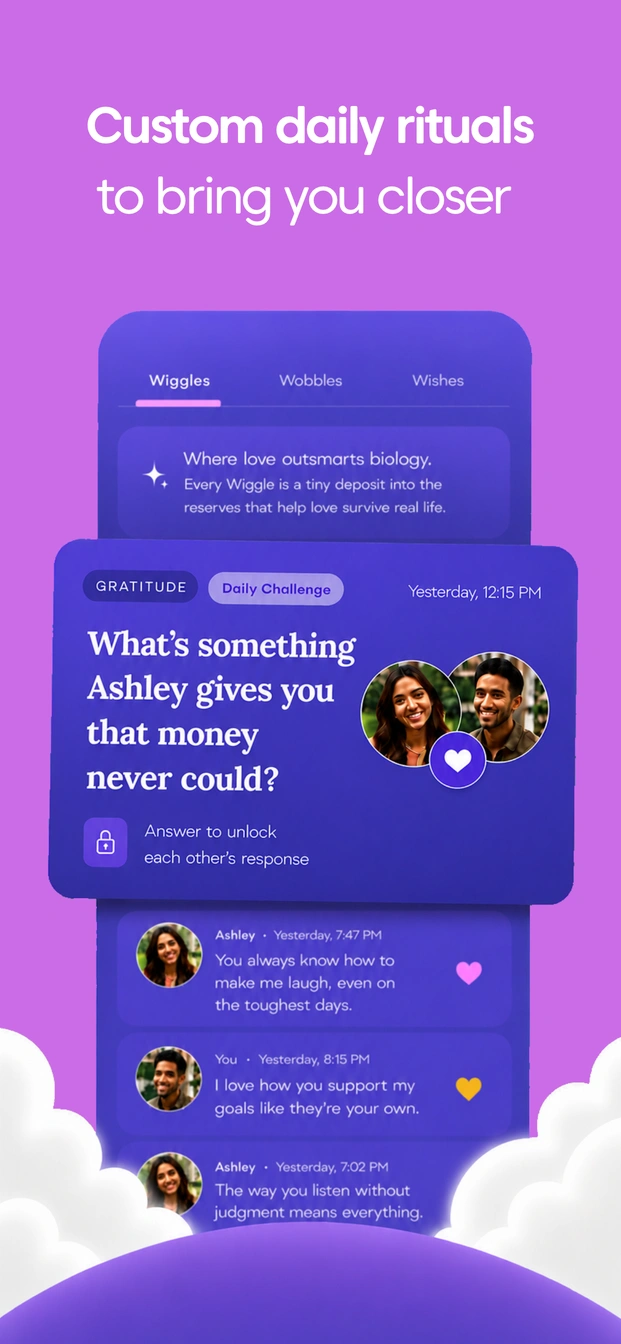
Daily questions for couples can give an ordinary conversation a starting point. Choose one question that suits the evening, hear the answer and ask what response would be welcome. Daily is an option, not a requirement. The point is to understand something about the person beside you, rather than finish a list.
Pick a question for the day you actually had
Before asking, check whether your partner wants a conversation. “Would you like one question while we have tea, or would quiet suit you better?” leaves room for either answer. You can also offer to listen later without requiring a reason for the delay.
Use these seven original prompts as a menu. Their weekday labels help you find an idea; they create no schedule to obey or questions to catch up on. On a difficult evening, choose the practical question. When you want a little play, leave the unfinished life plan alone.
- Monday: What is taking the most energy from you this week?
- Tuesday: What made you smile today that I might have missed?
- Wednesday: Where would practical help feel better than advice?
- Thursday: What is one thing you appreciated about us today?
- Friday: What would make this weekend feel restorative?
- Saturday: What is something playful or new we could try soon?
- Sunday: What should we carry forward, repair or release from this week?
Hear the answer before finding the solution
The NHS describes active listening as reflecting what somebody said or asking for details when something is unclear. Try one reflection, then let your partner correct it. You are checking understanding, rather than performing agreement.
In an original example, Mina answers the energy question: “The appointment is taking up my whole week.” Alex says, “Are you worried about what they might tell you?” Mina replies, “That too, but right now I cannot work out the transport.” The first interpretation was reasonable. It was also incomplete.
Alex can respond, “The travel is the part you need help with today. Have I got that?” A correction is useful information. It need not become an argument about how carefully you were listening. Nor does Mina have to reveal more about the appointment than she wants to.
Offer a response your partner can actually choose
Ask whether the answer calls for company, practical help or simply being heard. Those are options, not a test with one correct response. “Would you like me to look at transport with you?” gives Mina a choice. Taking over without asking might add a different problem.
If Mina welcomes help, Alex could offer, “I can check the bus route tonight and send you the times. Would that cover what you need?” Mina can accept, decline or ask for something different. Alex can be honest about what is possible without promising to handle every part of the appointment.
Some answers need no task. A funny moment might deserve a laugh and a follow-up question. Appreciation can receive a simple thank you. Avoid making every shared detail generate work; conversation is allowed to be enjoyable on its own.
Give a larger concern its own space
An answer may reveal something that cannot fit before bedtime. Acknowledge it rather than using the short format to dismiss it. “I hear that you have felt left alone with this. I want to understand properly. Would tomorrow after lunch work?” is an invitation your partner can respond to.
Agree a return point when both want one, and follow through. A daily prompt does not replace accountability for a missed agreement. If a partner wants a different outcome, including more distance or an ending, a question routine cannot require them to keep working towards closeness.
Where honest answers bring threats, monitoring or punishment, stop treating this as a shared communication exercise. Seek confidential specialist support independently. You do not owe personal disclosures to make the format work.
Keep the useful part and drop the pressure
The next evening, Alex can say, “I sent the bus times. Did that help, or is there still something you need to work out?” Mina has found a lift and wants company while she waits. Now Alex has a clearer choice: offer to come along if that works, or ask whether a call beforehand would be welcome. If the bus times never arrived, start by owning the missed promise.
For your own follow-up, go back to a detail you heard and ask how it turned out. Give your partner room to correct you or pass. You can leave the question there and enjoy the rest of the evening.
At the sink, “Anything happen today?” can still be a perfectly good question. What matters is having room for the answer, including the one you did not expect.