Back to blog

Relationship Check-In Questions for Couples Who Hate Check-Ins

Check-ins do not have to feel stiff. Try questions that sound like real people talking.

Swooni Team5 min read
The editorial and research team at Swooni
Relationship Check-In Questions for Couples Who Hate Check-Ins
check-inscommunicationquestions

Worth keeping in mind

  • A useful check-in should sound like real people talking.
  • Start with one honest question rather than a long relationship meeting.
  • The goal is one clear next move, not perfect answers.
A good check-in should feel less like a meeting and more like turning toward each other on purpose.

If the phrase "relationship check-in" makes you want to hide in the laundry room, fair. A lot of check-ins fail because they sound too big, too formal, or too close to a performance review.

A check-in is not an inspection. It is a pause long enough to notice what the week has been doing to the two of you before assumptions harden into distance.

Start with the smallest honest question

  • What felt good between us this week?
  • What did we avoid saying?
  • Where did you feel close to me?
  • Where did you feel like you had to handle things alone?
  • What is one small repair we could make before the week ends?

Keep the answer useful

The goal is not to collect perfect answers. The goal is to make one small truth easier to say.

Keep the check-in shorter than the dread around it

If one partner hears “check-in” and imagines an exhausting summit, agree on a limit before you begin. Ten minutes and one question can be enough. The boundary makes honesty safer because neither person fears that a single answer will open every unresolved subject at once. If something larger appears, write it down and choose a separate time rather than forcing the current conversation to carry it.

Alternate who chooses the question so the habit does not belong to one partner alone. One week might focus on appreciation; another might ask what felt heavy or where support was missed. End by summarizing one thing you understood and one action you will try. Do not grade the conversation afterward. The purpose is to keep the relationship visible, not to prove that both people are equally skilled at talking on demand.

A check-in can also be quiet. Ask whether they would like one question while the kettle boils or a text they can answer later. Offer an easy exit: ‘Would you like to tell me one thing that felt heavy this week? We can leave it today.’ If they say no, let the invitation end there.

Leave time-sensitive shared decisions out of that invitation. ‘Can we confirm who will take the car in tomorrow?’ still needs an answer, even if neither person wants to discuss the week. Ask about the car directly. If speaking up feels unsafe or prompts retaliation, consider confidential individual support.

Use questions that do not sound like a meeting agenda

Try sideways questions: What did this week ask too much of you? Which moment should we delete, repeat, or give an award? Where did you need backup? What are we pretending is not annoying? Which plan would make Sunday easier? The language can be ordinary while the answer remains useful.

Use choice to reduce dread. Offer two questions and let the reluctant partner choose, or alternate who brings one. Ask while walking, driving somewhere familiar, or making food if direct eye contact feels like an interview. Keep the time boundary visible and finish when you said you would.

Allow compressed answers. A colour, weather report, or number can open enough context: ‘This week was foggy; I kept losing track of us.’ The other partner asks one follow-up rather than demanding a complete emotional account. Short answers are not inferior when they create honest contact.

Remove the reasons the check-in has become unpleasant

If every check-in becomes a complaint list, add appreciation and limit repair to one subject. If one person does all the emotional administration, alternate initiation and action. If answers are used later as ammunition, rebuild safety before continuing. If the timing is consistently poor, stop blaming commitment and change the design.

A check-in is optional support, not a requirement for a healthy relationship. Some couples communicate better through shared activity, voice notes, or spontaneous short conversations. Keep the principle of regular mutual attention and discard the format that makes both people brace.

Try the one-question month

If you both want to try it, use ‘What would make the next seven days easier for us?’ once a week. A reply can be as simple as ‘Could Thursday be a quiet evening?’ Ask what quiet would look like and agree any practical change. After four weeks, each say whether you want to keep the question, change it or stop.

Quick answers

Frequently asked questions

What is a good relationship check-in question?

A good question is specific and easy to answer honestly, such as: What felt good between us this week?

How often should couples check in?

Many couples do well with short weekly check-ins, but the best rhythm is one both partners can actually keep.

Your everyday couples app

Give your next check-in a place to begin.

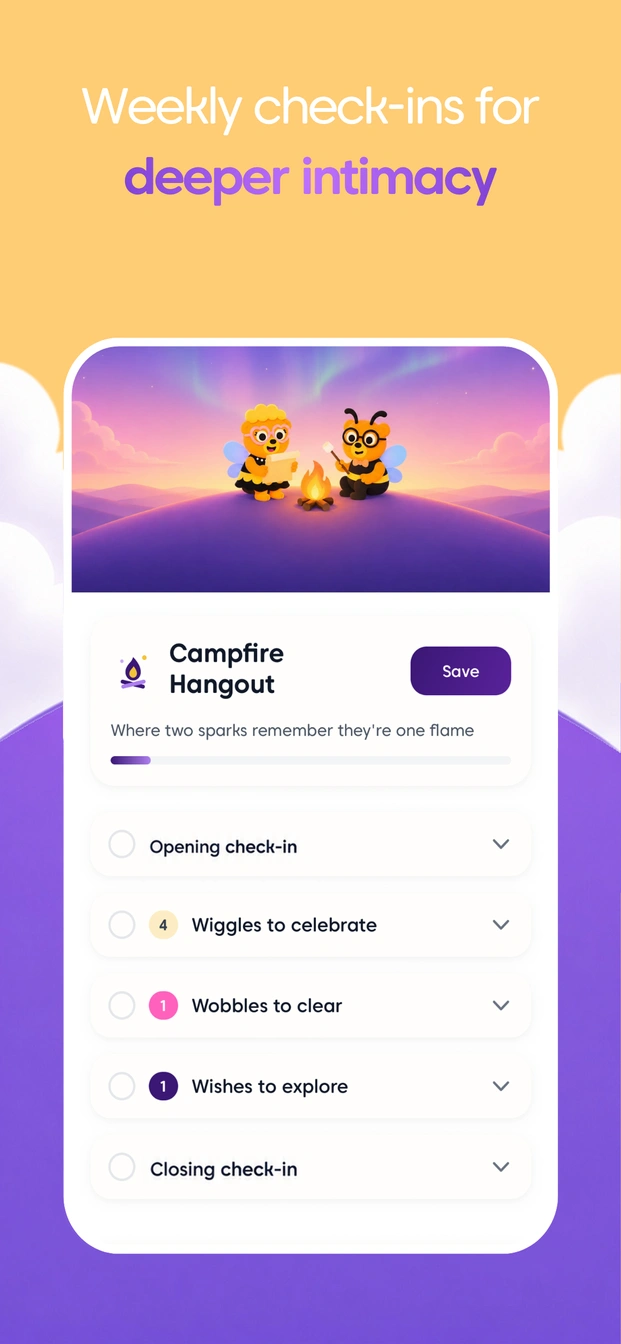
Swooni's Campfire gives you space to celebrate the good, talk through friction, and explore what you both need next.

Download on the App StoreGet it on Google Play

The Gottman Magic Ratio made accessible for everyday couples.

Swooni Campfire with Opening check-in, shared reflections, and Closing check-in

Our mission

We're making the scientific formula for lasting love accessible to every couple, everywhere.