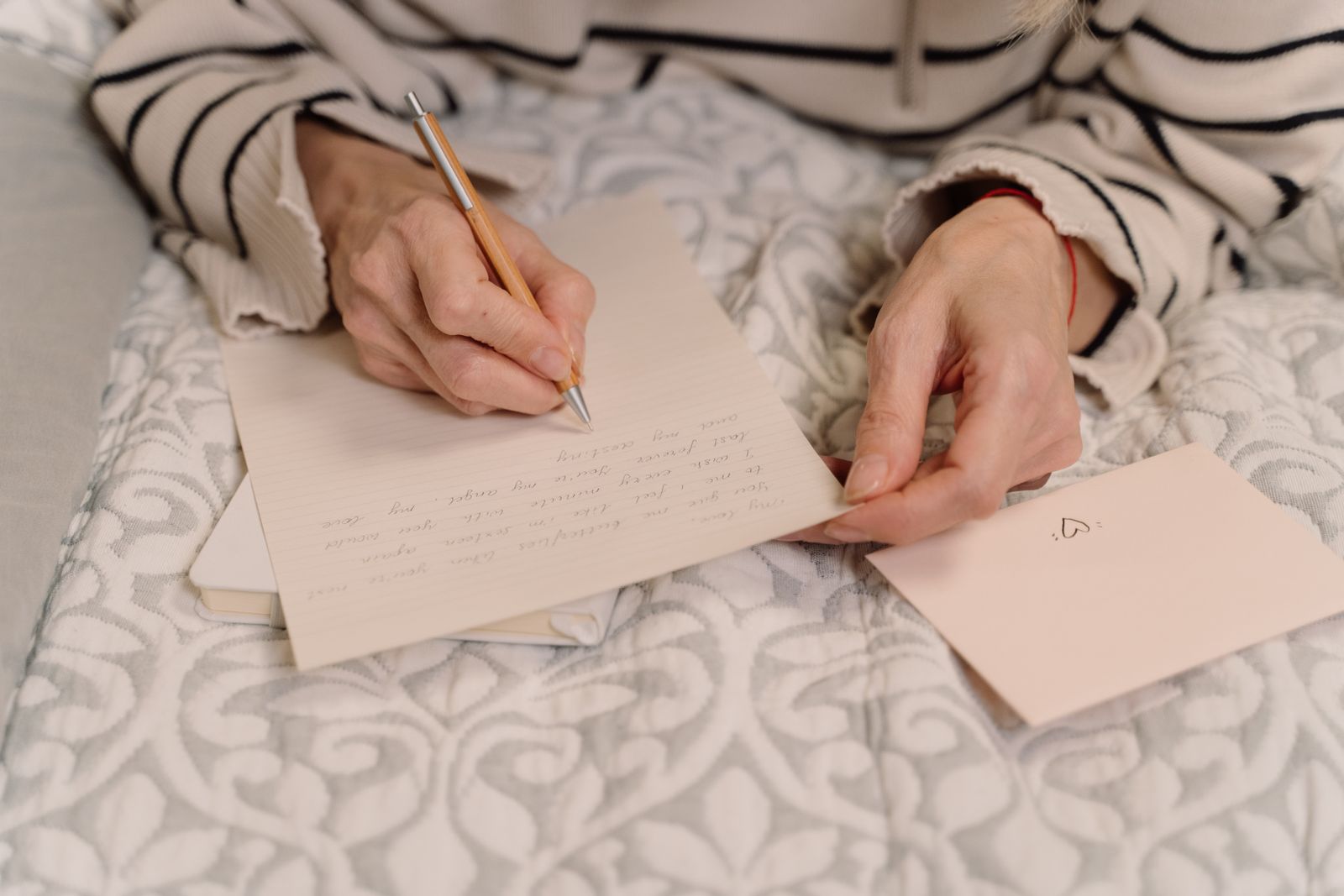
Begin with something only you would have noticed about this person.
The card is open beside your tea. You have written “Dear” and your partner's name, then spent several minutes looking at the kettle. You have plenty of feelings. Apparently none of them came with sentences. If you are wondering how to write a love letter, start with one real moment, say what it means to you and choose an ending you can honestly stand behind. Your partner does not need a stranger's perfect declaration. Give them something recognisably yours.
Decide what this letter is for
Choose a purpose before trying to sound romantic. Perhaps you want to mark an anniversary, describe what you miss while apart, or say something you keep thinking but never quite say. Finish this sentence privately: “I am writing because I want you to know…” That gives the letter a direction.
A love letter can be a few lines in a card, an email or a longer handwritten page. Choose a form your partner welcomes and you can manage. Handwriting is optional; so are decorative paper and the ability to spell without checking. If reading is difficult or unwelcome, ask whether they would prefer you to read the words aloud or make a private voice message.
Check what you are asking the letter to do. Affection can accompany an apology, but it cannot supply the accountability. If you hurt someone, name what you did and what you will change in a separate, clear apology. Do not wrap a request for forgiveness in enough compliments that declining it becomes difficult.
Find a detail before reaching for a grand phrase
Think of a recent moment: how they listened to their friend, the ridiculous commentary on a rainy walk, or the way they kept practising something difficult. Write down what happened before deciding what it means. “You stayed curious when we disagreed about the film” offers more to recognise than “You are perfect.”
The Gottman Institute's guidance on fondness and admiration encourages naming qualities you appreciate and the incidents where you noticed them. It also distinguishes appreciation for who someone is from thanks for what they do for you. Use that principle to choose your own detail. The letter structure and examples here are original editorial suggestions, not a reproduced Gottman exercise or a treatment programme.
Try three rough notes: a moment you remember, a quality you admire and something you enjoy about being with them. You might write “missed bus”, “finds humour without dismissing my frustration” and “our improvised breakfast”. These notes are raw material. They do not all need to appear in the finished letter.
Avoid praising someone mainly for having no needs. “You never complain” may celebrate the silence you benefit from. Look for qualities you value even when the person disagrees with you, needs rest or asks you to share responsibility.
Source:The Gottman Institute, sharing fondness and admiration
Build a first draft you can actually finish
Use this simple sequence if the blank page keeps winning: why you are writing, one specific memory, what you appreciate and a truthful close. You can change the order once you have something on the page. There is no required length or number of memories.
An ordinary first draft might read: “I wanted to tell you something I enjoyed this week. When we missed the bus, you suggested breakfast at that tiny café instead. I liked how you made room for a good morning without pretending the delay wasn't annoying. I enjoy your company, even when the plan falls apart. Love, Sam.”
Notice the scale of the ending. It says something true about the relationship without promising that nothing will ever change. If a future wish belongs in your letter, make it specific and honest: “I would love more mornings like that” or “I want to keep making time for us.” Leave out promises you do not mean or cannot reasonably make.
Read the draft aloud. Replace any phrase you would feel strange saying to this person. Keep a familiar nickname only if they like it. You can be tender, funny or straightforward; a letter does not need to audition for a period drama. One recognisable sentence is a useful place to begin.
Four original examples for different moments
These examples show different choices, not words to send unchanged. Replace the memory, tone and closing with your own. The same approach works for a girlfriend, boyfriend, spouse or partner; gender does not tell you what kind of affection someone wants.
A short everyday note: “I keep thinking about our walk yesterday. You stopped to look at the tiny plants growing through the wall, and suddenly I noticed them too. I like the attention you give things. I loved having that unhurried hour with you.”
An anniversary letter: “When I think about this year, I remember us assembling the bookshelf with the instructions upside down. I liked how we could laugh, admit our mistake and begin again. There have been difficult days too, and I don't want to pretend otherwise. Today I want to say that I value the life we are choosing together, and the room we make to enjoy it.”
A letter across distance: “I missed your running commentary while I cooked tonight. I tried describing the spectacularly uneven pancakes to myself; the audience was disappointing. I enjoy hearing how you see ordinary things. I am looking forward to our next call and hearing what caught your attention this week.”
A quieter letter during a hard week: “I have seen how much thought you have put into that difficult decision. I admire the care you are taking, even without a clear answer yet. You don't have to sound cheerful for me. I love you, and I would like to ask what kind of company would feel welcome tonight.”
If none fits, return to your notes rather than forcing an example into your relationship. A birthday letter might celebrate an interest they are pursuing. A new relationship may call for “I enjoy getting to know you” rather than a declaration of lifelong certainty. Match the words to where you actually are.
Give the words somewhere welcome to land
A private card may suit one person; another might enjoy a message they can read when they have time. Ask if you are unsure: “I wrote something affectionate for you. Would you like it now, or later?” Avoid making someone read it aloud in front of guests unless they have chosen that.
Discuss sharing separately from receiving. love is respect's digital-boundaries guidance encourages couples to agree what can be posted publicly and recognises each person's right to privacy. For your letter, ask before photographing, forwarding or publishing it, especially when it contains private details about your partner or someone else.
Let the response be theirs. A quiet thank-you, time to read or an awkward smile does not require you to demand a better performance. Do not use a letter to bargain for sex, immediate forgiveness or a matching declaration. Respect a request for space or no contact; writing your feelings privately does not entitle you to deliver them.
Source:love is respect, digital boundaries and public sharing
Edit for truth, then stop polishing
Before sending, check whether each memory belongs to you, each compliment is sincere and each promise is one you intend to keep. Remove comparisons with an ex, hidden criticism and claims about what your partner must feel. “I felt close to you that evening” leaves them room to describe their own experience.
If you used a template or writing tool, replace its generic praise with details you can verify. Do not include private information about your partner in a service without checking how it handles that information and whether your partner agrees to the disclosure. You remain responsible for the words you send.
Now read it once as the recipient. Is there anything to explain, answer or perform immediately? If so, decide whether that belongs in a separate conversation. Sign the letter, choose the moment and let it be a human attempt rather than a flawless one. The tea may have gone cold. The page finally has something only you could have written.